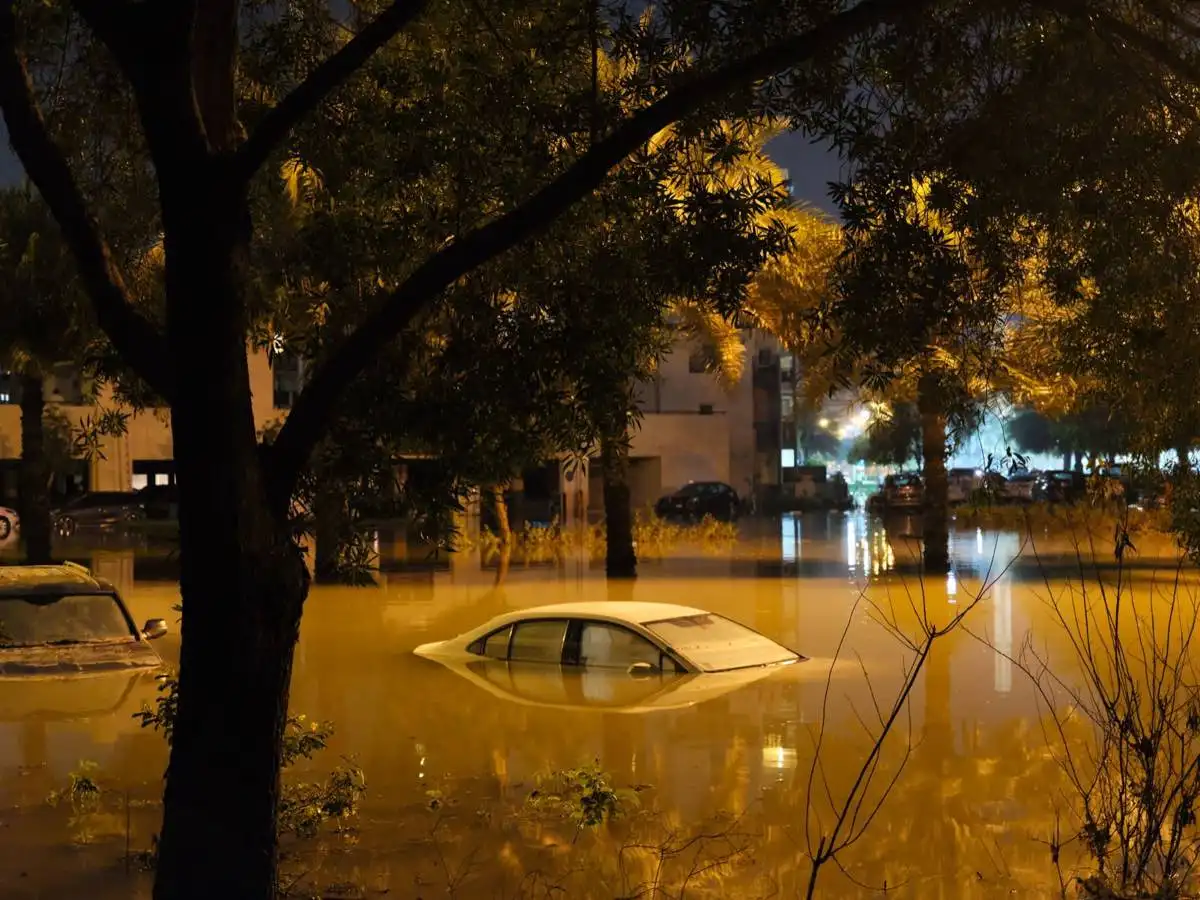
Secondary water damage is the damage caused by high humidity after a water loss, rather than by the water itself — cupped hardwood in a room the water never reached, swollen baseboards, peeling paint, corroded fasteners and a musty smell coming out of a wall cavity. The water left. The humidity stayed and quietly redecorated.
This is the part of a water loss that nobody photographs on day one, because on day one there is nothing to see. It shows up on day four, in materials that were bone dry when the pipe failed.
Primary versus secondary, in one line
Primary damage is what got wet. Secondary damage is what the resulting air did. Contamination level is a separate question entirely, and we covered that in the categories of water damage — a Category 1 loss can still cause a great deal of secondary damage if the drying is slow.
Here is the physics in plain English. Every wet material in the building is evaporating into the air, and that air can only hold so much. Once indoor humidity climbs, the moisture starts moving into dry materials, because vapor always travels from higher vapor pressure toward lower. Your dry oak floor is now the driest thing in the room, which makes it the target.
What high humidity actually ruins
| Material | What happens | Recoverable? |
|---|---|---|
| Solid hardwood | Cups from moisture underneath, crowns when it dries unevenly | Often, with slow controlled drying, sometimes with a later sand |
| Engineered wood | Face veneer delaminates from the core | Rarely |
| Laminate | Core swells at the seams and edges chip | No |
| MDF baseboard and casing | Swells at the bottom edge, paint splits | No, it gets replaced |
| Cabinet toe kicks and particleboard | Swells, crumbles, loses fastener grip | No |
| Drywall paper | Softens, then grows microbial life | Depends on how long |
| Fiberglass insulation | Mats down and loses most of its R-value | Usually replaced |
| Fasteners and hardware | Rust, corrosion, staining bleeding through paint | Replaced, and the stains need blocking primer |
| Paper, books, photographs | Cockle, stick, spot | Sometimes, with specialist drying |
| Electronics | Condensation on cold internal surfaces | Unpredictable |
Your MDF baseboard is essentially a sponge wearing a costume. It looks like trim until the day it does not, and then it is a wood-flour biscuit that never returns to its original shape.
The tannin and rust problem
Two visual signs of secondary damage that people misread. Brown or amber staining bleeding through paint is tannin migrating out of wood as it dries, and it will keep bleeding through ordinary latex until you seal it with a shellac or oil-based stain-blocking primer. Rust rings around nail and screw heads are corrosion from days of high humidity, and they mean the fastener has been wet, which is a useful clue about how far the moisture spread.
Why fans and open windows often make it worse
Here is the strong opinion for this post, and it is the one that saves the most money: a box fan and an open window are not a drying plan, and on a humid day they actively cause secondary damage.
Air movers do one job — they strip the saturated boundary layer off a wet surface so evaporation continues. That is useful, and it is also the problem: all that water now goes into the room air. If nothing removes it from there, you have traded a wet floor for a humid house, and the humid house goes to work on everything else.
The measurement that matters is not relative humidity, it is specific humidity in grains per pound, because relative humidity changes with temperature while grains per pound tells you how much water is actually in the air. Room air at 70 degrees and 60 percent relative humidity carries roughly 65 grains per pound. Drying crews aim to pull the indoor air well below that and hold it there.
That is what an LGR dehumidifier is for. Low grain refrigerant units run a second cooling stage, so they keep condensing down around 40 grains per pound, the region where a conventional refrigerant unit has effectively quit. It is worth knowing where that number comes from, because it gets repeated as though it were a standard: it is manufacturer performance literature. Dri-Eaz and other restoration equipment makers publish sub-40-grain performance for their LGR lines, and it is not a figure out of IICRC S500. What S500 contributes is the sizing — its published dehumidification factor chart treats conventional refrigerant, LGR and desiccant as three distinct machine types, and does not rate a conventional unit for a Class 4 loss at all. In cold conditions, or with water deeply bound in hardwood, plaster or concrete, a desiccant takes over, because it adsorbs moisture rather than chilling air below its dew point.
And this is why crews close the building instead of airing it out. Opening windows helps only if the outdoor air is genuinely drier in grains per pound. On a muggy Broken Arrow afternoon it is not, and you are importing the exact thing you are trying to remove.
The timeline of secondary damage
- Hours 0 to 24. Humidity climbs. Nothing visible. This is the window where you either win or lose.
- Hours 24 to 48. Microbial growth commonly begins on damp organic material. Odor starts, faintly.
- Days 2 to 5. Hardwood cupping becomes obvious. MDF baseboards swell. Paint blisters. Musty smell is now unmistakable.
- Week 2 and beyond. Fastener corrosion, tannin staining, insulation that has lost its R-value, and cavity growth you cannot see without opening a wall.
Nothing on that list happened because of the original water. It happened because the air stayed wet.
How professional drying stops it
The whole point of a proper dry-out is to keep the air drier than the materials, so moisture leaves the building rather than migrating around inside it: water extraction first, because pulled water never becomes vapor, then air movers along the affected walls, then enough dehumidification capacity to keep up with everything they release.
Then the part that makes it verifiable, and the part Broken Arrow Water Damage Pros will not skip: daily readings on affected and unaffected materials, plus a thermo-hygrometer log of the room conditions. A drying job is finished when the affected material meters the same as an unaffected reference of the same stuff, typically after 3 to 5 days, and longer for Class 4 losses with bound water. If nobody is logging grains per pound alongside those material readings, nobody actually knows whether secondary damage is being prevented or just hoped away. The full timeline is in how long water damage takes to dry.
When you can genuinely relax about it
Not every wet floor turns into this. The test is whether the event carried enough water to shift the room's humidity at all. A clean-water spill in the 10-square-foot range on a hard sealed surface, mopped up inside a couple of hours, with no carpet pad, drywall or wood involved, did not. Secondary damage is not coming for you. Towel it, fan it, meter it at 24 hours, and stop reading.
Same for a small leak inside a bathroom vanity that you caught the same day. Pull the contents out, dry the cabinet floor, and check that the toe kick has not swelled. If it is firm, you are fine, and no Broken Arrow restoration company needs to hear about it.
The bottom line
Secondary water damage is a humidity problem, and humidity is measured in grains per pound rather than by how the room feels. Extract fast, dehumidify hard, close the windows, and verify with readings against a dry standard. Do that and the water only damages what it touched. Skip it and a modest leak quietly costs you a hardwood floor, a run of baseboard, a set of cabinet toe kicks and eventually a mold remediation job.
Broken Arrow Water Damage Pros runs structural drying with LGR dehumidification and daily documented readings across Broken Arrow and the Tulsa metro, and we will tell you when a spill is too small to bother with. Call (888) 684-5470 if the numbers on your own meter are not dropping.
Ready for a free quote in Broken Arrow?
Broken Arrow Water Damage Pros — free estimate, clear scope, no pressure. Use the form on this page or jump to the homepage quote.
Related services in Broken Arrow
Broken Arrow Water Damage Pros money pages — go straight to the service you need.
- Emergency Water Extraction →
Extraction is the cheapest hour of the whole job and the one that decides the rest of it. Every hour standing water sits, it moves further into pad, base plate and cavity insulation, and the drying bill grows faster than the extraction bill ever would.
- Flood Damage Restoration →
Most Broken Arrow calls that start with the word flood are not floods. Insurance uses the term narrowly: surface water from outside the building, generally affecting two or more acres or two or more properties.
- Mold Remediation →
Mold is a moisture problem wearing a costume. We do not treat it as a cleaning job, because if the water source and the wet material are still there, the growth comes back in the same square foot.
- Structural Drying & Dehumidification →
Drying is a measurement job, not a fan-rental job. We set a dry standard from an unaffected part of the same building, then run equipment until the wet materials read at or below it.
- Storm, Hail & Wind Damage →
Oklahoma does not get hurricanes, so this page is about what it does get: hail, straight-line wind and the tornado-adjacent damage that happens a mile off the track. The building gets opened, and then it rains into it.
Frequently asked questions
What is secondary water damage?
It is damage caused by high humidity and vapor after a water loss, rather than by contact with the water itself. Cupped hardwood two rooms away, swollen MDF baseboards, peeling paint, corroded fasteners and musty cavity odor are all secondary. The water never touched those things; the air did.
How is secondary damage different from primary damage?
Primary damage is what the water physically soaked. Secondary damage is what the resulting humidity ruined afterwards, often in places the water never reached. The distinction matters because secondary damage keeps developing after the puddle is gone, which is why a job is finished by meter readings rather than by appearance.
How long does it take for secondary damage to start?
It begins as soon as the humidity climbs, and becomes visible over the following days. Microbial growth on damp organic material is commonly cited as starting within 24 to 48 hours, while hardwood cupping and MDF swelling usually show over several days. Every one of those clocks starts before anything looks wrong.
Can secondary water damage be prevented?
Largely, yes, by extracting fast and then holding the indoor air dry with commercial dehumidification rather than fans alone. The goal is to keep pulling moisture out of the air faster than the wet materials release it. That is why crews close the building up instead of opening the windows.
Does opening windows help dry a house after a leak?
Sometimes, and often it makes things worse. Bringing in outdoor air only helps if that air is genuinely drier than the indoor air, measured in grains per pound rather than by relative humidity. On a humid day you are importing the exact moisture you are trying to remove.
Is secondary water damage covered by insurance?
It depends on your policy and on whether the underlying loss was covered, and coverage is decided by your carrier rather than by any restoration company. Mold sub-limits and maintenance exclusions come up often in these discussions. Read your declarations page or ask your adjuster before assuming either way.
Local context
How this applies in Broken Arrow, OK
Every article here is written from water damage work done in Broken Arrow and the Tulsa metro, so the numbers reflect local labour, permit and material costs rather than a national average. Your own job can land either side of them depending on access, the condition of what is already there, and the materials you pick — the ANSI/IICRC S500 water damage standard, the IICRC S520 mold remediation reference guide, low-grain refrigerant dehumidifiers.
The way to turn any of this into a real answer is to have someone look at your actual situation. The free estimate is free, itemized and written down, with no deposit and no obligation. Call (888) 684-5470 or start on the Broken Arrow Water Damage Pros homepage.
Areas Broken Arrow Water Damage Pros covers
Broken Arrow first, then the surrounding communities of the Tulsa metro. Each has its own page with local detail rather than a copy of this one:
- Bixby, OK — Tulsa County, population 28,609 at the 2020 census
- Jenks, OK — Tulsa County, population 25,949 at the 2020 census
- Owasso, OK — Tulsa County, population 38,240 at the 2020 census
- Coweta, OK — Wagoner County, population 9,654 at the 2020 census
- Catoosa, OK — Rogers County, population 7,440 at the 2020 census
- Claremore, OK — Rogers County, population 19,580 at the 2020 census
Or jump to the full list of Broken Arrow services.
More from the Broken Arrow Water Damage Pros blog
- Emergency Water Extraction Process in Broken Arrow
Safety check, stop the source, extract, set drying, monitor daily, document. What emergency water extraction really involves in Broken Arrow, OK homes.
- Ceiling Water Damage in Broken Arrow: Stains and Sagging
A growing or sagging ceiling stain is active and a collapse risk. How to find the source, when to stay clear, and what to fix in a Broken Arrow, OK home.
- Categories of Water Damage Explained (Broken Arrow)
Category 1 is clean, 2 is gray, 3 is black. What each one means under IICRC S500, how fast they degrade, and what it changes in Broken Arrow, OK.
The Broken Arrow Water Damage Pros Team
water damage specialists serving Broken Arrow, OK
Written by the Broken Arrow Water Damage Pros team — insured water damage pros with 15+ years serving Broken Arrow, OK and the surrounding area.