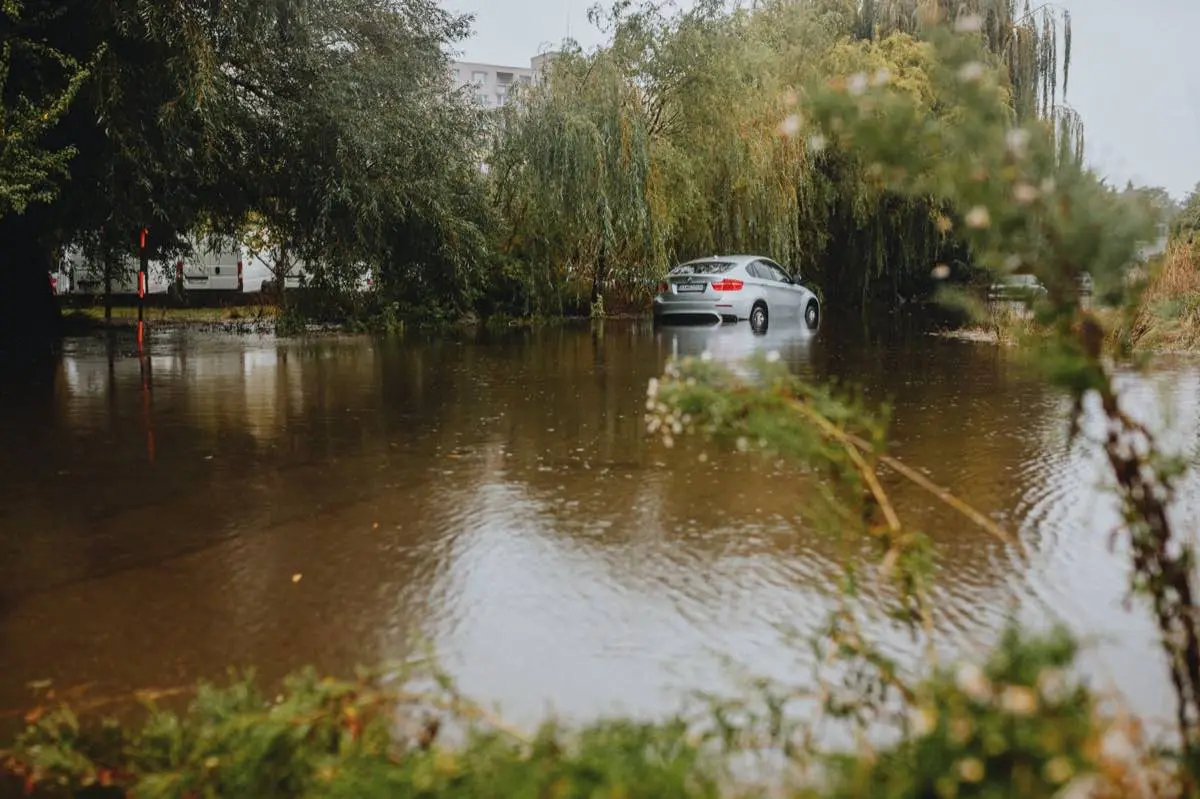
Water damage restoration in Broken Arrow runs about $1,300 to $6,300 for most homes, with the average job around $3,800. A small clean-water leak can be a few hundred dollars; a sewage backup or a room that sat wet for days can climb well past $10,000. The number swings that wide for one reason: it depends on how dirty the water was, how much of your home it touched, and how long it sat before anyone started drying.
Here's the scene we get called about most. It's 6am, you pad into the kitchen for coffee in socks, and the socks come back wet. Somewhere behind the wall a supply line let go around midnight, and your floor has been a shallow pond for six hours. Now you're standing in it, doing math you never wanted to do.
So let's do that math honestly, in plain English, before anyone hands you a quote.
What water damage restoration actually costs
Across the industry, typical water damage repair cost falls in that $1,300 to $6,300 window, averaging near $3,800. Those are real ranges, not a sales pitch. Where you land inside them comes down to a handful of factors:
- How clean the water was (a burst pipe is cheap to handle; sewage is not)
- How much area got wet (one ceiling vs. three rooms)
- What it soaked (drywall and carpet dry out; hardwood and cabinets often don't)
- How long it sat (every hour the water waits, the job and the bill grow)
That last one is the part nobody tells you. Restoration is priced on damage, and damage keeps happening until the water is gone. Move fast and you're often paying to dry things out. Wait a week and you're paying to rebuild them.
Cost by water type: clean, gray, and black
Restoration pros sort water into three categories, and the category sets the price more than almost anything else. Dirtier water means more protective gear, more disposal, and more sanitizing.
| Water type | What it is | Typical cost per sq. ft. |
|---|---|---|
| Clean (Category 1) | Supply lines, rain, a leaky faucet | $3 – $4 |
| Gray (Category 2) | Dishwasher, washing machine, shower drain | $4 – $7 |
| Black (Category 3) | Sewage, toilet backups, outside flood water | $7 – $15 |
Black water is the expensive one because it's a health hazard, not just a mess. Anything porous it touched — carpet, pad, soaked drywall — usually gets removed and replaced rather than dried. If your water came from a sewage backup or an outside flood, plan for the top of that range.
Cost by area of your home
The other big lever is square footage. A stain on one ceiling is a different animal than a soaked open-plan floor. Rough ranges for a full restoration by area:
| Affected area | Typical restoration cost |
|---|---|
| One ceiling or small spot (under 150 sq. ft.) | $450 – $2,000 |
| A single room | $2,000 – $5,000 |
| Bathroom (behind tile and subfloor) | $1,000 – $5,000 |
| Kitchen (cabinets and flooring involved) | $2,000 – $8,000 |
| Multiple rooms or a whole floor | $8,000 – $25,000 |
If mold has already started — and in the Tulsa metro humidity that can happen within 24 to 48 hours — add mold remediation on top, usually $1,200 to $3,750 for a contained job. Which is exactly why speed saves money.
The part your quote won't spell out: two bills, not one
Here's the thing most cost guides blur together. "Restoration" is really two separate jobs with two separate prices.
- Mitigation (the dry-out). Extract the standing water, then run air movers and dehumidifiers for a few days until the framing and subfloor are dry to the core. This runs about $4 to $8 per square foot of affected area. It's the part that stops the damage.
- Reconstruction (the rebuild). New drywall, paint, flooring, cabinets — putting the house back the way it was. This is priced like any remodel and varies wildly.
Some homes only ever need the first job. If we catch a clean-water leak fast and the structural drying works, the drywall and floors survive and there's little to rebuild. That's the best-case bill, and it's the whole argument for calling the moment you find water instead of the following Monday. If you're wondering how long that dry-out actually takes, we broke it down in how long water damage takes to dry.
What insurance actually covers (and quietly denies)
This is where most people get surprised, so read this part twice. A standard homeowners policy usually covers water damage that's sudden and accidental, and denies damage from gradual leaks or neglect. Same house, same soggy carpet — the story of how it got wet decides who pays.
Typically covered:
- A pipe or supply line that bursts
- A water heater or appliance that fails
- Rain getting in through sudden storm damage to the roof
Typically denied:
- A slow leak you knew about (or should have) and didn't fix
- Long-term seepage, rot, or mold from a drip that ran for months
- Flood — rising water from outside, like storm surge or an overflowing arroyo. A regular policy never covers that; you need separate flood insurance. In the the Tulsa metro, that's the gap that burns people after a hard rain.
Take the bathroom question everyone Googles. A supply line under the vanity that lets go overnight? Covered. A shower pan that's been weeping behind the tile since last year? That's the denied pile. It's worth knowing which story is yours before you file, because a good restoration crew documents moisture readings and photos either way — and that paperwork is often what gets a legitimate claim paid.
The cheapest quote is rarely the cheapest job
Here's our one strong opinion, and we'll stand on it: the low bid that skips moisture testing is the most expensive quote on the table — you just pay for it in three weeks.
A crew that shows up, sucks out the water you can see, sets a couple of fans, and leaves is drying the surface, not the structure. The moisture trapped inside the wall cavity and under the subfloor doesn't show up on a phone camera. It shows up a month later as a musty smell and a black bloom behind the baseboard, and now you're paying for mold remediation and a wall you already "fixed." A real restoration measures moisture with meters and a thermal camera and doesn't stop until the numbers hit dry. That costs a little more on day one and saves you a demolition later.
When you can skip the pro
We'd rather tell you the truth than land a job. If it's a small, clean spill you caught immediately — a glass of water, an overflowed sink you mopped in ten minutes, a spot smaller than a bath towel — you don't need us. Pull up any wet rug, point a fan at it, check that it's genuinely dry a day later, and get on with your life.
Call a pro when the water was dirty, when it sat for more than a few hours, when it got into walls, cabinets, or flooring, or when you can smell it. Those are the ones that quietly turn into the five-figure jobs if you wait.
The bottom line
Budget $1,300 to $6,300 for a typical Broken Arrow water damage job, knowing clean-and-fast lands low and dirty-and-delayed lands high. The single cheapest move you can make is picking up the phone before the water sits — mitigation is far cheaper than reconstruction, and dry framing doesn't grow mold.
If you're standing in it right now, Broken Arrow Water Damage Pros runs 24/7 across Broken Arrow and the Tulsa metro with free inspections, honest moisture readings, and direct insurance billing so you deal with the flood, not the paperwork. Call (888) 684-5470 and we'll give you a real number, not a guess.
Ready for a free quote in Broken Arrow?
Broken Arrow Water Damage Pros — free estimate, clear scope, no pressure. Use the form on this page or jump to the homepage quote.
Related services in Broken Arrow
Broken Arrow Water Damage Pros money pages — go straight to the service you need.
- Emergency Water Extraction →
Extraction is the cheapest hour of the whole job and the one that decides the rest of it. Every hour standing water sits, it moves further into pad, base plate and cavity insulation, and the drying bill grows faster than the extraction bill ever would.
- Structural Drying & Dehumidification →
Drying is a measurement job, not a fan-rental job. We set a dry standard from an unaffected part of the same building, then run equipment until the wet materials read at or below it.
- Mold Remediation →
Mold is a moisture problem wearing a costume. We do not treat it as a cleaning job, because if the water source and the wet material are still there, the growth comes back in the same square foot.
- Flood Damage Restoration →
Most Broken Arrow calls that start with the word flood are not floods. Insurance uses the term narrowly: surface water from outside the building, generally affecting two or more acres or two or more properties.
- Storm, Hail & Wind Damage →
Oklahoma does not get hurricanes, so this page is about what it does get: hail, straight-line wind and the tornado-adjacent damage that happens a mile off the track. The building gets opened, and then it rains into it.
Frequently asked questions
How much does it cost to repair water damage in a house?
Most Broken Arrow homeowners pay between $1,300 and $6,300, with the average job landing around $3,800. Clean-water jobs sit at the low end; a sewage backup or a room that soaked for days pushes to the high end. A free inspection is the only way to get a real number — call (888) 684-5470.
Will homeowners insurance cover water damage in a bathroom?
Usually yes, if it was sudden and accidental — a supply line under the sink lets go, a toilet overflows. What insurers deny is the slow leak nobody fixed: a running toilet or a shower pan seeping for months reads as neglect, not an accident. Same bathroom, very different answer.
Is water damage expensive to fix?
It can be, but the bill tracks the water. A wet spot on one ceiling might run $450 to $2,000. A flooded kitchen or a whole soaked floor climbs into five figures. The single biggest cost driver is how long the water sat before drying started.
Does insurance cover flood damage restoration cost?
A standard homeowners policy does not cover rising outside water — storm surge, an overflowing arroyo, street flooding. That needs separate flood insurance. It does cover most internal failures like burst pipes. In the the Tulsa metro, that gap catches a lot of people after a big rain.
How much does it cost to dry out a house after water damage?
The dry-out (extraction plus a few days of air movers and dehumidifiers) typically runs $4 to $8 per square foot of affected area. That is the mitigation half of the bill, separate from any rebuild. Drying a couple of rooms usually falls in the $2,000 to $5,000 range.
Local context
How this applies in Broken Arrow, OK
Every article here is written from water damage work done in Broken Arrow and the Tulsa metro, so the numbers reflect local labour, permit and material costs rather than a national average. Your own job can land either side of them depending on access, the condition of what is already there, and the materials you pick — the ANSI/IICRC S500 water damage standard, the IICRC S520 mold remediation reference guide, low-grain refrigerant dehumidifiers.
The way to turn any of this into a real answer is to have someone look at your actual situation. The free estimate is free, itemized and written down, with no deposit and no obligation. Call (888) 684-5470 or start on the Broken Arrow Water Damage Pros homepage.
Areas Broken Arrow Water Damage Pros covers
Broken Arrow first, then the surrounding communities of the Tulsa metro. Each has its own page with local detail rather than a copy of this one:
- Bixby, OK — Tulsa County, population 28,609 at the 2020 census
- Jenks, OK — Tulsa County, population 25,949 at the 2020 census
- Owasso, OK — Tulsa County, population 38,240 at the 2020 census
- Coweta, OK — Wagoner County, population 9,654 at the 2020 census
- Catoosa, OK — Rogers County, population 7,440 at the 2020 census
- Claremore, OK — Rogers County, population 19,580 at the 2020 census
Or jump to the full list of Broken Arrow services.
More from the Broken Arrow Water Damage Pros blog
- Signs of Water Damage in a House (Broken Arrow Guide)
Musty smell, stains that grow, soft floors, peeling paint. The real signs of water damage in a house and how to check yours in Broken Arrow, OK.
- Mold After Water Damage in Broken Arrow: The 48-Hour Clock
Mold can start within 24 to 48 hours of water sitting. What to dry, what the EPA 10 sq ft rule means, and when to call a pro in Broken Arrow, OK.
- How Long Does Water Damage Take to Dry? Broken Arrow
Surface water dries in 24-48 hours with pro equipment; walls and framing take 3-5+ days. The real water-damage drying timeline for Broken Arrow, OK.
The Broken Arrow Water Damage Pros Team
water damage specialists serving Broken Arrow, OK
Written by the Broken Arrow Water Damage Pros team — insured water damage pros with 15+ years serving Broken Arrow, OK and the surrounding area.